
The Third Places of the Offshore World
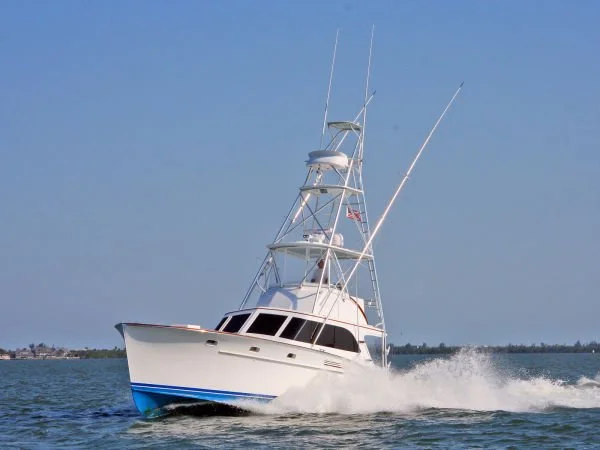
Twenty — built to run, even when the ocean had other plans
Where the day doesn’t end when the lines come in
There’s a moment offshore that doesn’t get talked about much.
It happens after the last line is in.
After the cockpit’s washed down.
After the rods are back in their holders and the ocean finally lets you go.
The fishing is over.
But nobody’s ready to leave.
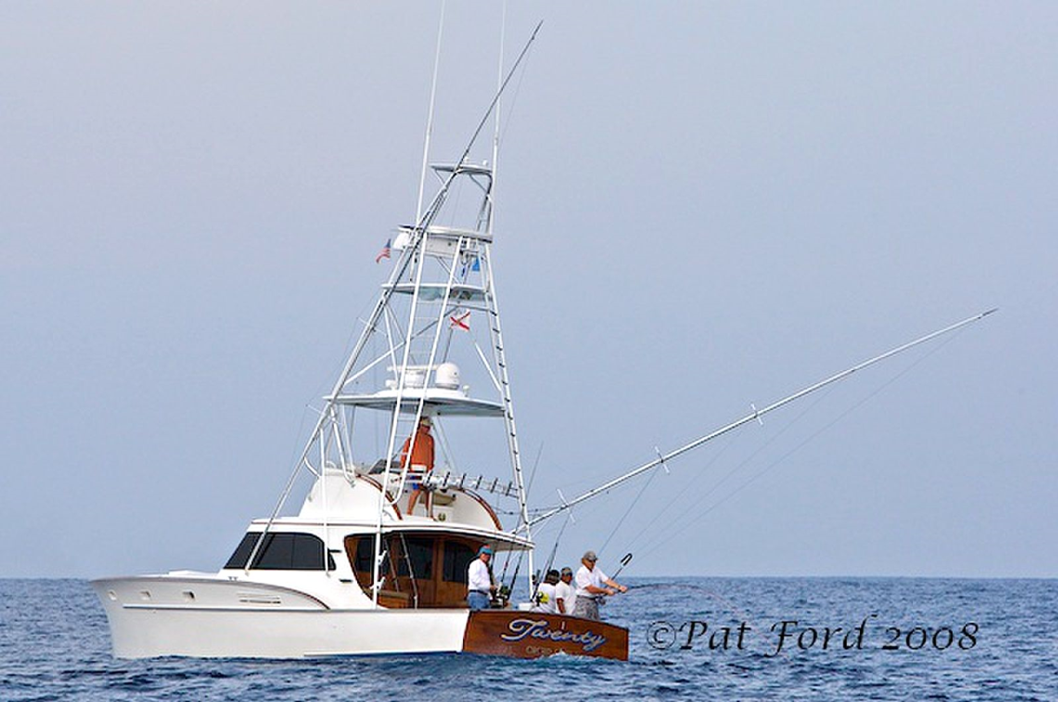
Running back from Bimini once aboard my old Rybovich, Twenty, a 1955 forty-footer. One of the cleanest, most perfectly proportioned boats Tommy ever drew.
She wasn’t fast. Eighteen knots on a good day, downhill with the current.
We cut the trip a day short on a bad forecast.
Didn’t matter.
The front came through early.
What should have been a three-hour ride home turned into six hours of work. The kind of run where the ocean doesn’t let you cheat it. Every mile earned. Every mistake noticed.
That old Rybovich never changed her attitude.
She just kept going.
Steady. Shoulders into it. Taking it on the nose the whole way like she’d done it before and wasn’t interested in discussing it.
The sea was loud.
The crew wasn’t.
Nobody talked much. There wasn’t anything to say that would make it easier, and everybody on board knew it. You settle into your own head on runs like that. Watch the water. Watch the rhythm. Trust the man at the wheel.
Time stretches out in a strange way.
Hours feel longer, but simpler.
You stop thinking about where you are and start thinking about getting through what’s in front of you.
Eventually, Fowey Light came into view.
Not dramatic. No cheering. Just a quiet shift in the air.
A little later we slid past Stiltsville into Biscayne Bay. It was still rough, but everyone knew the worst of it was behind us.
You could feel it before anyone said it.
That moment when the pressure comes off.
Someone finally exhales.
Someone else leans back for the first time in hours.
No one calls it out.
But everyone feels it.
I’d heard people say they wanted to kiss the ground after a hard trip.
That day, I understood it.
That’s what I mean when I talk about third places offshore.
And here’s the part most people miss.
That moment didn’t end when we tied up.
It followed us.
You’ll see it if you pay attention.
The crew lingers.
Someone leans against the covering boards.
Another guy wipes something that’s already clean.
The captain slows things down just enough on the ride home that nobody has to say it out loud.
Nobody wants to be the first one to break it.
Because that space right there…
that in-between moment…
That’s one of the offshore world’s third places.
Most people think third places are bars.
That’s the easy answer.
A stool. A drink. A place to tell stories after the fact.
And yeah, those matter. They always have. Every great fishing town has one. The kind of place where the bartender knows which boat you’re on and doesn’t ask if you had a good day. He already knows by how you walked in.
But offshore, it starts earlier than that.
It starts before the bar.
Out there, third places aren’t built.
They form.
They show up in the same spots over and over again, like the ocean itself decided they belong there.
The edge of a canyon where three boats always seem to drift within shouting distance.
A rig that holds more conversation than fish some days.
A stretch of blue water where you slow down, not because you have to… but because everyone else did.
No one plans it.
But everyone recognizes it.
And then there’s the boat itself.
Not the whole boat.
Just the cockpit.
More specifically… the transom.
That’s where it happens.
That’s where a crew becomes something else.
You can fish with a group of guys all day and still not know who they are.
Fishing hides things.
It gives everyone a job.
A role.
A reason to stay busy.
But when it’s over, and there’s nothing left to do but stand there with salt drying on your skin and the sound of the water sliding past the hull…
That’s when people show themselves.
Conversations start that weren’t happening before.
Not loud. Not dramatic.
Just honest.
“That fish almost beat us.”
“You handled that better than I thought you would.”
“We got lucky today.”
No speeches.
No announcements.
Just small truths, handed across the transom like tools.
That’s where the hierarchy settles itself.
Not by title. Not by who paid for the trip.
By what happens when it matters.
We fished the Flor de Caña tournament in Nicaragua a while back. Ran Rum Line down from Guatemala. We’d done well the year before and came back expecting the same.
One of the anglers couldn’t make it that year.
So another guy brought a client to fill the spot.
You could tell how that was going to go before the first line ever hit the water.
Captain’s meeting the night before, the guy got into the local rum a little too hard. Not unusual. Just… more than most.
Next morning, lines in at eight.
He’s fifteen minutes late to the boat.
His condo was a hundred feet from the dock.
He shows up loud.
Stories. Opinions. Past trips. The whole thing.
Nobody said anything.
We just turned the music up.
First couple sails come in.
He catches them.
Not clean. Not pretty.
But legal releases.
Music goes up a little more.
Then a blue marlin shows up.
Quiet boat all of a sudden.
He’s on the pitch.
Perfect bite.
And he blows it.
Nobody said a word.
Didn’t need to.
He got quiet.
Music went down.
Everyone on that boat knew what that fish meant.
Late in the day, just before lines out, he gets another shot.
This time he listens.
Captain Chris calls it.
He follows it.
Clean release.
High fives.
Good run home.
And somewhere in that stretch between the bite and the dock…
something shifted.
He wasn’t talking as much.
Wasn’t trying to lead the room.
Just… there.
Part of it now.
Of course, he drank too much again that night.
Overslept again the next morning.
We didn’t wait for him that day.
He missed the boat.
That’s how it works.
Not cruel.
Not personal.
Just… clear.
The ocean doesn’t care what you said at the dock.
And the boat sits in the middle of it all.
Not as a backdrop.
As the thing that made it possible.
A good boat doesn’t just get you to the fish.
It decides how people move once they get there.
Tight spaces create tension.
Clean layouts create rhythm.
When everything is where it should be, nobody has to think about the boat.
And when nobody’s thinking about the boat… they start paying attention to each other.
That’s where a crew turns into something more.
Not because of the day.
Because of how the boat let it happen.
Later, yeah… it moves to the bar.
It always does.
That’s where the stories get shaped.
Where the edges get sanded down or sharpened, depending on who’s listening.
Where the same fish gets told three different ways, and somehow all of them are true.
But by the time you get there, the important part already happened.
The bar is where you talk about it.
The transom is where it became real.
That’s the thing most people miss about this life.
They think it’s about the catch.
Or the numbers.
Or the places.
And those things matter.
But they’re not what stays with you.
What stays with you is where you were standing when it happened.
Who was next to you.
What was said… and what didn’t need to be.
I can still see that cockpit. Salt dried on the teak. Nobody saying much.
Every offshore life ends up with a map.
Not the one on the chartplotter.
The other one.
The one in your head.
Marked not by coordinates…
…but by moments.
A cockpit at dusk.
A slow ride home.
A barstool with a wet ring under your glass.
Third places.
The ones that don’t show up on any chart.
But somehow…
are the only places that really matter.
